INDUSTRY EVOLUTION · ERP STRATEGY · AUSTRALIAN MANUFACTURING
Australian manufacturers have spent years, and significant capital, digitising their operations. ERP systems went in. IoT sensors followed. Dashboards multiplied. So why does the next industrial era demand a fundamentally different conversation, rather than simply an extension of the last one?
The distinction matters, particularly for mid-market manufacturers still navigating the legacy challenges of the previous wave while being asked to prepare for the next one.
THE FOUNDATION
What Industry 4.0 Delivered
Industry 4.0 was, at its core, a technology story. The Internet of Things, cloud computing, artificial intelligence and advanced robotics transformed manufacturing operations globally. The promise was simple: connect everything, automate where possible, and let data drive decisions.
In Australia, this played out unevenly. According to the Advanced Manufacturing Growth Centre (AMGC), which co-invested in over 161 industry-led collaborative projects before transitioning into its expanded Industry Partner Organisation role under the Australian Government's Industry Growth Program in 2025, the sector made meaningful progress — but the gains concentrated among larger manufacturers with dedicated IT functions. Mid-market businesses, constrained by cost, workforce capability and legacy system complexity, often found themselves caught between aspirational digitalisation strategies and operational reality.
ERP systems were Industry 4.0's central nervous system. They consolidated data, connected finance with operations, and provided the transactional backbone that made automation meaningful. But they were configured almost universally around a single objective: efficiency. Throughput. Cost per unit. On-time delivery. The KPIs were operational, the orientation was inward, and the assumption was stability.
WHAT ACTUALLY CHANGES
The Three Pillars of Industry 5.0
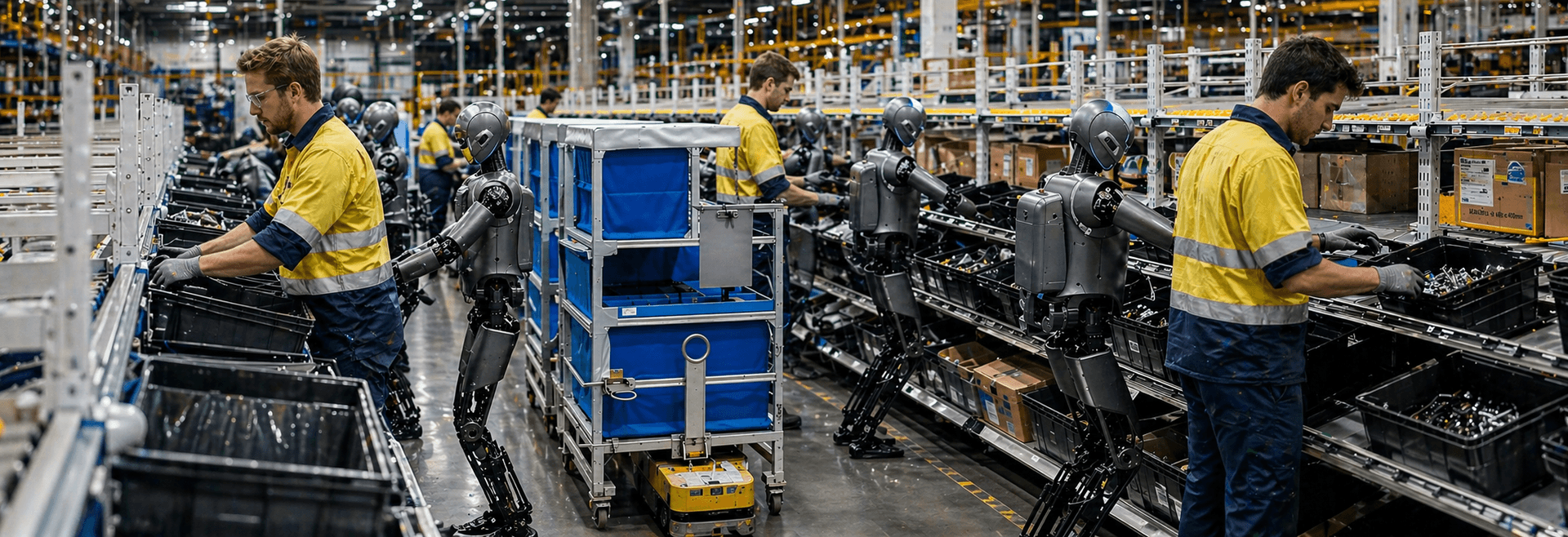
Industry 5.0 is not a replacement for Industry 4.0. Researchers from Springer Nature and Frontiers in Manufacturing Technology characterise it as a logical continuation — one that places people, resilience and sustainability alongside, and in some cases ahead of, pure efficiency as industrial goals.
- Human-centricity: workers shift from process monitors to co-creators and decision-makers, with the emphasis moving from replacing human labour to augmenting human capability with intelligent systems
- Resilience: organisations must anticipate, absorb and recover from disruption — supply chain shocks, energy volatility, demand variability — rather than optimise only for conditions that assume stability
- Sustainability: industrial growth must align with environmental and social outcomes, increasingly as a commercial and regulatory expectation, not only an ethical one
Industry 4.0 asked: how do we make this process faster and cheaper? Industry 5.0 asks: how do we make this operation adaptable, sustainable, and worth doing for the people inside it? These are different questions, and they require different answers from the ERP systems underpinning them.
| Dimension | Industry 4.0 | Industry 5.0 |
| Focus | Automation and efficiency | Human-machine collaboration |
| Goal | Productivity and speed | Resilience, sustainability and personalisation |
| Worker role | Monitors processes | Co-creator and decision-maker |
| Technology | IoT, AI, robotics | Cobots, AI-augmentation, digital twins |
| ERP role | System of record | System of intelligence and empowerment |
| Outcome | Smart factory | Human-centric, resilient factory |
THE AUSTRALIAN CONTEXT
Growing Output, Shrinking Margin
Manufacturing accounts for approximately 5.9% of Australia's GDP as of 2025 and employs around 870,000 people. Industry Value Added grew from $132.6 billion to $134.8 billion — a 1.6% increase — in the year to June 2024. Yet profitability pressure is mounting: EBITDA in manufacturing declined by $3.6 billion over the same period, pointing to a sector growing in output while being squeezed on margin.
| Metric | Figure |
| Manufacturing share of Australian GDP (2025) | ~5.9% |
| People employed in manufacturing | ~870,000 |
| Industry Value Added, year to June 2024 | $132.6bn → $134.8bn (+1.6%) |
| EBITDA change, same period | Down $3.6 billion |
| Australian ERP market size (2024) | AUD 2.52 billion |
| ERP market growth, 2025–2034 | 15.2% CAGR |
| Year-on-year rise in unfilled manufacturing vacancies | 8.2% |
THE ERP QUESTION
From System of Record to System of Intelligence
For Australian manufacturers with existing ERP implementations, adopting Industry 5.0 principles does not require ripping out what is already in place. It requires a fundamentally different question to be asked of those systems. Under Industry 4.0 logic, ERP was configured to report on what happened — inventory consumed, orders fulfilled, variance against standard. Valuable data, but retrospective in orientation and transactional in purpose.
Industry 5.0 demands ERP evolve into something more active. Three capabilities become central:
- Decision support at the human level: actionable insight placed directly in the hands of operators, supervisors and planners, extending human judgment rather than circumventing it
- Resilience as an operating parameter: scenario modelling, single-source dependency flags, and dynamic re-routing of production and procurement built into the system — not just tracking what is happening, but anticipating what could
- Workforce enablement, not workforce displacement: systems designed for the workforce that exists, intuitive and contextual rather than administratively burdensome, addressing the 8.2% year-on-year rise in unfilled manufacturing vacancies that ERP investment alone does not resolve
THE MID-MARKET REALITY
Four Compounding Pressures
Global frameworks like Industry 5.0 are frequently developed with large-enterprise conditions in mind. The mid-market reality in Australia — typically businesses with revenues between $10 million and $250 million, across food and beverage, industrial manufacturing, building products, and defence supply chains — is considerably more nuanced. These businesses face four compounding pressures:
- Legacy ERP environments implemented for compliance and cost control, not adaptability
- Workforce capability gaps that make advanced system configuration and data interpretation difficult
- Capital constraints limiting the pace of technology investment even when the business case is clear
- Geographic and supply chain exposure, particularly for regional manufacturers, that creates resilience vulnerability
The transition from Industry 4.0 to Industry 5.0 in this context is less a technology project and more an organisational and strategic one. The ERP system is a tool. The real question is whether the business has the leadership clarity, process maturity and workforce capability to extract its full potential, and to direct it toward the right outcomes.
THREE PRACTICAL SHIFTS
Where to Start Looking
- Audit ERP configuration, not just ERP capability — many mid-market systems are technically capable of supporting Industry 5.0 objectives but remain configured around Industry 4.0 conditions. The diagnostic question: what are the current system's outputs actually being used for, and by whom?
- Reframe the workforce conversation — manufacturers who treat ERP implementation as a technology project, rather than a change-management and capability-building program, consistently underperform on return
- Build resilience into planning cycles — scenario modelling, supplier risk scoring, and demand-sensing capability exist and are increasingly accessible at mid-market price points; the strategic question is whether they're actively used or sitting unopened in a menu
Cloud-based ERP adoption in Australia is growing at over 20% annually, with mid-market enterprises driving a significant share of that growth. Adoption alone is not the metric that matters — it is the capability gap between what systems can do and how organisations are configured to use them that determines whether ERP investment translates into genuine Industry 5.0 readiness.
Is your ERP system configured for the industrial era you are operating in — or the one you implemented it for? A structured readiness assessment across system configuration, workforce capability, and resilience design is a practical starting point for any mid-market manufacturer asking this question.
Sources: Australian Bureau of Statistics · Advanced Manufacturing Growth Centre · Expert Market Research Australia · European Commission Industry 5.0 Framework · Springer Nature · Frontiers in Manufacturing Technology
Australian Mid-Market Manufacturing · Industry 5.0 · ThynkProcess