“We need more automation.” “We can’t find skilled workers.” “Our supply chain is broken.” I hear these three statements in almost every boardroom I walk into. They’re not wrong. But they are, in most cases, the symptom — not the disease.
Three sentences come up in almost every conversation ThynkProcess has with Australian mid-market manufacturers: “We need more automation.” “We can't find skilled workers.” “Our supply chain is broken.”
None of these statements are wrong. But in most cases, each one is a symptom rather than the actual disease — and treating the symptom is exactly why the underlying problem never gets solved.
| The example below is drawn from a real ThynkProcess client engagement. Identifying details, including the name used, have been changed to protect the client's confidentiality. |
THE SCENE
A Clear Diagnosis, and the One Question That Changed It
Consider a $60 million food processing manufacturer in regional Victoria — a strong customer base, a solid product, and three consecutive years of quiet margin compression. The managing director, referred to here as David, had a clear diagnosis: automate the packing line, and find workers who would actually show up. He had already spoken with three equipment vendors and two recruiters, and was ready to commit capital.
Before any contract was signed, one question changed the direction of the entire project: what does your production data actually tell you about where time is being lost on the floor?
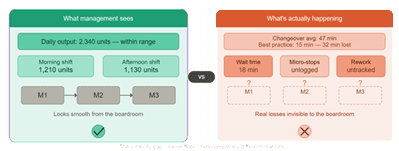
David paused. He didn't have production data — not really. He had output numbers logged at the end of each shift. That was the extent of it.
He wasn't facing an automation problem, and he wasn't facing a workforce problem. He was facing a visibility problem, and no amount of robotic packing equipment was ever going to fix that.
THE PATTERN
One Crisis, Wearing Three Different Masks
This is not an isolated case. Across Australian mid-market manufacturers — businesses turning over between $20 million and $200 million — automation, workforce, and supply chain concerns are rarely three separate crises. They are one crisis wearing three different masks, and the mask is almost always the same: a fundamental lack of operational visibility at the floor level.
Three dynamics keep this pattern in place, and none of them reflect poorly on the operators involved:
- Equipment vendors and automation consultants are incentivised to sell solutions, not diagnose root causes — and they are very good at what they do
- Mid-market leadership teams are time-poor and understandably pattern-match from industry coverage, which is currently dominated by automation and skills-shortage headlines
- Advisors themselves sometimes follow a client's energy rather than challenge it, because it is easier to help someone buy new equipment than to say their operational data isn't ready to support that decision yet
WHAT ACTUALLY WORKED
Six Weeks, No New Technology, One Real Answer
Before David signed a single vendor contract, ThynkProcess spent six weeks doing something deliberately unglamorous: mapping exactly where time, material, and labour were actually going on the floor. The method was simple — stopwatches, spreadsheets, and direct observation. No expensive software was involved.
What that mapping found would have made the planned investment almost entirely redundant. The biggest loss wasn't on the packing line David wanted to automate — it was in changeover time between product runs, untracked and unmanaged, averaging 47 minutes against a best-practice benchmark of under 15 minutes for that equipment type.
Fixing changeover time first revealed spare capacity on the packing line that nobody knew existed. The workforce “shortage” became a workforce misallocation. And supply chain buffers — originally sized to compensate for unpredictable internal capacity — could finally be trimmed with confidence.
| Operational Factor | Before Visibility | After Visibility |
| Changeover time | Averaging 47 minutes, untracked and unmanaged | Reduced toward the sub-15-minute benchmark for the equipment type |
| Packing line capacity | Believed to be maxed out; automation proposed to add capacity | Spare capacity revealed once changeover time was recovered |
| Workforce position | Framed as a shortage; recruitment underway | Reframed as a misallocation, not a headcount problem |
| Supply chain buffers | Oversized to compensate for unpredictable internal capacity | Trimmed once internal capacity became predictable |
Three separate problems dissolved into one. And that one problem had a solution costing a fraction of what David had originally been prepared to spend.
THE OPPORTUNITY
For Australian Manufacturers, Right Now
Australian mid-market manufacturing sits at a genuinely favourable inflection point. Several tailwinds are converging at once:
| Tailwind | What It Means for Mid-Market Manufacturers |
| Reshoring momentum | More domestic demand is arriving for manufacturers who can prove reliable capacity and quality |
| Government support | Programs including AMGC initiatives are lowering the barrier to co-invest in operational improvement |
| Accessible automation | Automation technology once reserved for large enterprise is increasingly viable at mid-market price points |
| Affordable digital tools | The tools needed to build real floor-level visibility no longer require enterprise-scale budgets |
But that opportunity will be captured by the manufacturers who invest in understanding their operations before they invest in changing them — not by those who purchase the most impressive equipment in response to the latest industry headline.
The manufacturers who pull ahead over the next decade won't necessarily be the ones who automate fastest. They will be the ones who know exactly what they are automating, and why, before a single dollar is committed.
How many mid-market manufacturers have a clear, real-time picture of where time and margin are actually being lost on their floor — not an estimate, but data? And for those who do, what changed once they got it?