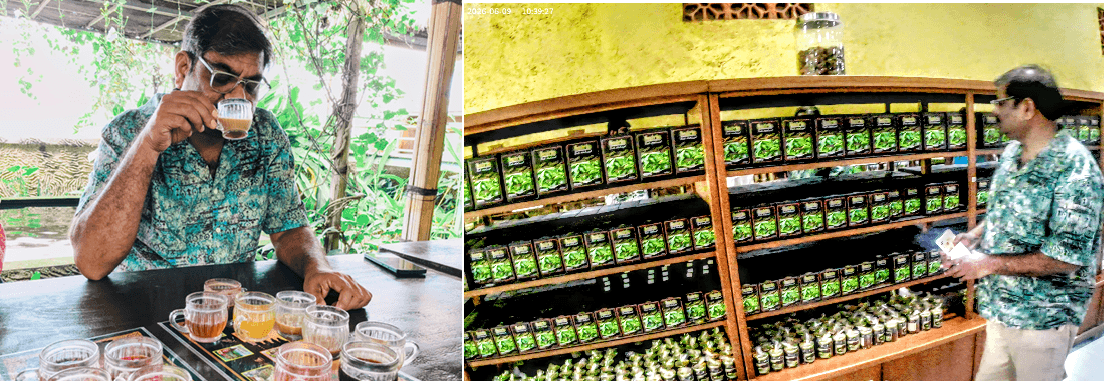
Ten small cups. Each a different colour. Ginger, haldi, mangosteen, rosella, lemongrass — and somewhere in the middle, a dark, intensely aromatic Balinese coffee that stopped me completely.
This wasn't a café. It was a plantation tasting room, open to the sky, surrounded by tropical greenery, somewhere in the hills of Bali. And somewhere between the third and fourth cup, my brain switched — involuntarily — from holiday mode to industry mode.
The experience
A cup of coffee with a long supply chain behind it
The plantation visit had started simply enough — a guided walk through the growing plots, learning how the coffee cherry develops, how different varietals express themselves in different soils, and how the processing method — wet, dry, or semi-washed — fundamentally changes what ends up in the cup. The guide spoke with the quiet confidence of someone who has grown up around these plants.
What struck me immediately was the range. This wasn't just a coffee plantation in the narrow sense. It was a producer of botanical drinks — coffees, herbal infusions, spiced teas — each with its own flavour profile, its own harvest window, its own processing requirement. Ginger harvested at different maturities. Haldi — turmeric — dried and ground to very specific moisture content. Mangosteen processed to preserve the delicate floral notes that disappear quickly after harvest. The complexity behind each small cup was considerable.
And then we walked into the retail outlet.
The retail outlet
Where craft meets commerce — and packaging does serious work
Floor-to-ceiling shelves. Rows of neatly packaged boxes and tins — the Intrio Bali Natural range — stacked with a precision that would look at home in any premium food retailer. Tourists from a dozen countries browsing, picking things up, reading labels, buying. Japanese visitors, Australians, Europeans — all taking Balinese products home in their luggage.
That's when the professional observation arrived fully formed: every single one of these products has to survive a journey.
A tin of Balinese ginger coffee bought that morning in Ubud might end up in a kitchen in Melbourne, Mumbai, or Munich within 48 hours. It needs to maintain aroma integrity through pressure changes in an aircraft hold. It needs a label that communicates correctly under food import regulations in multiple jurisdictions. The packaging has to protect the product through humidity, temperature variation, and the indignity of a checked baggage carousel.
And that's just the tourist trade. Scale this to commercial export — to containers, to cold chain logistics, to retail compliance requirements across markets with different standards — and the packaging question becomes one of the most operationally complex and commercially significant decisions any food producer makes.
The bigger picture
Food in the global village — and the invisible infrastructure that makes it possible
We live in an era where a premium product grown in the highlands of Bali can sit on a supermarket shelf in Sydney, compete with locally produced alternatives, and command a price premium based on provenance and story. That is genuinely extraordinary — and it is made possible almost entirely by the invisible infrastructure of food processing, food safety, and packaging technology.
The numbers behind this are significant. The global food packaging market is currently valued at over $412 billion and is projected to reach nearly $693 billion by 2036, growing at a compound annual rate of 5.3%. Asia Pacific alone accounts for 38% of that market — a region where food producers like those in Bali are increasingly sophisticated participants, not just raw material suppliers.
What's driving that growth isn't simply population increase or rising incomes — though both play a role. It's a structural shift in how food is produced, distributed, and consumed globally. Packaging formats are evolving from basic containment toward performance-driven solutions that prioritise barrier protection, shelf-life extension, and product integrity across complex cold-chain and last-mile logistics networks.
In plain terms: the world's food supply chain is getting longer, more complex, and more demanding — and the packaging that holds it together is becoming a genuine competitive differentiator, not just a cost line.
"The food packaging market sits at the intersection of consumer convenience, food safety, supply-chain efficiency, and sustainability." — Future Market Insights, 2026
Sustainability is no longer a peripheral consideration either. The same Balinese products that tourists carry home today will face tightening import packaging regulations in their destination markets within the next three to five years. European single-use plastics directives, Australian packaging sustainability targets, and shifting consumer expectations are all converging — creating both pressure and opportunity for producers who move early.
The Australian context
What this means for food manufacturers here at home
Standing in that Balinese retail outlet, looking at products that compete directly with Australian-made alternatives on supermarket shelves and in online stores globally, the competitive reality is impossible to ignore.
Australian food and beverage manufacturers operate in one of the most sophisticated and demanding consumer markets in the world. They are held to high food safety standards, face significant sustainability expectations, and compete with increasingly capable producers from across the Asia Pacific region — many of whom, like the Balinese producers visited on this trip, combine genuine craft with rapidly improving processing and packaging capability.
he manufacturers who will sustain advantage in this environment won't simply be those who produce the best product. They'll be the ones who understand the full journey their product takes — from the production floor to the consumer's hands — and who have optimised every step of that journey. Processing efficiency. Packaging integrity. Shelf-life performance. Regulatory compliance across markets. Sustainability credentials that can be clearly communicated.
These are not separate operational questions. They are one connected question about how well a business understands and manages its process — from paddock to packaging to purchase.
The close
From Bali to Melbourne — and why the timing matters
Back in Australia now — and that tasting flight in Bali has stayed with me in the way that genuinely useful experiences do. Not as a holiday memory, but as a reminder that the food industry's most interesting challenges aren't abstract. They're present in every cup, every tin, every shelf.
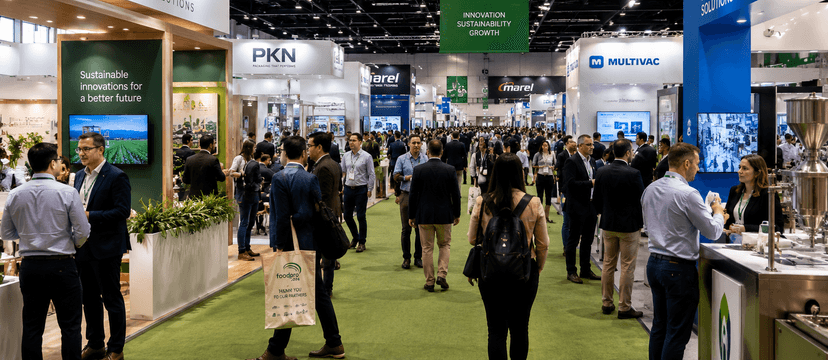
If the questions raised here — about processing technology, packaging innovation, sustainability, and global competitiveness — are live ones for your business, there is one event this year where they will all be addressed under the same roof: foodpro 2026, Melbourne Convention and Exhibition Centre, 26–29 July.
Four hundred exhibitors. Nine thousand industry professionals. Australia's only major food processing and packaging trade event of the year. The Innovation Stage running daily sessions on automation, AI-driven quality control, sustainable packaging and food safety regulation. And the kind of peer-to-peer conversations that only happen when the whole industry is in one place.
Sometimes the most clarifying industry insights arrive not in a conference room, but over a tasting flight in Bali. The next best option is Melbourne in July.
Are you heading to foodpro 2026? What are the questions you most want answered while you're there? Drop a comment — always interested in what's front of mind for Australian food and beverage manufacturers right now.
#foodpro2026 #BaliCoffee #FoodManufacturing #AustralianManufacturing #FoodPackaging #GlobalFoodTrade #ThynkProcess #OperationalExcellence #FoodAndBeverage #Melbourne #Bali
Sources: Future Market Insights Food Packaging Market Report 2026–2036 · Precedence Research Food Packaging Market 2026 · Grand View Research Food Packaging Market Analysis 2026