
Australia's mid-market food and beverage sector is at a systems crossroads. Businesses that scaled through spreadsheets, disconnected applications, and manual workarounds are now confronting the limits of that approach — in costing accuracy, in recall readiness, in contract pricing, in margin visibility. The question being asked in boardrooms across the sector is no longer whether to implement enterprise software, but which platform is actually built for the way these businesses operate.
This article examines that question directly — across three distinct operator types in the Australian F&B sector: manufacturers, wholesale distributors, and packagers.
First, why not just pick any mid-market ERP?
There is no shortage of ERP options for mid-market businesses. Microsoft Dynamics 365 Business Central, Oracle NetSuite, MYOB Acumatica, Epicor, SYSPRO — all are credible, all have Australian implementations behind them. The question is not which platform has the most features in aggregate. The question is which platform is purpose-fitted to the operational realities of F&B businesses in the $20 million to $150 million revenue range.
That question has a more specific answer than many businesses realise when they start an ERP evaluation. Food and beverage manufacturing is not generic manufacturing. Wholesale distribution of perishables is not generic distribution. F&B packaging is not generic contract manufacturing. Each carries a set of operational requirements — batch traceability, shelf life control, recipe/formula management, catch weight handling, rebate and contract pricing complexity — that generic platforms handle partially, inconsistently, or only with the addition of specialist third-party modules.
The right ERP question for F&B isn't 'which platform is most popular?' It's 'which platform handles our operational complexity natively, at mid-market cost, without a five-year implementation?'
SAP Business One has been the answer to that question for thousands of mid-market food and beverage businesses globally, and for a growing number of Australian operators. Here is why — segment by segment.
SEGMENT ONE
Food and Beverage Manufacturers
The operational complexity generic ERPs underestimate
A food manufacturer's ERP isn't just a finance system with production bolted on. It needs to manage production at the recipe level, not just the bill-of-materials level. It needs to handle yield variability — the fact that 100kg of input ingredients rarely produces exactly 100kg of finished product. It needs to track every batch from raw material receipt through production through finished goods despatch, in a way that supports a recall response in hours, not days.
FSANZ coordinated 92 food recalls in 2025, above the ten-year average of 87, with undeclared allergens responsible for 38% of them. The majority of those recalls trace back to failures in recipe management, ingredient change communication, and labelling processes — exactly the processes a well-implemented F&B ERP is designed to control. FSANZ's own analysis puts the average direct cost of a recall at around $10 million, before reputational damage is factored in.
What SAP Business One delivers for manufacturers
SAP Business One addresses the core manufacturing requirements of F&B operators through a combination of native functionality and a mature add-on ecosystem:
- Recipe and formula management via multi-level Bill of Materials (BOM), with automatic updating of raw material requirements and production costs whenever a recipe is modified. Any change to a formulation flows immediately through to cost calculations and MRP planning.
- Batch and lot traceability from raw material intake through to finished goods despatch, with forward and backward traceability across the full production chain. In the event of a recall or FSANZ audit, affected batches can be identified and isolated within the system rather than across disconnected spreadsheets and paper records.
- Catch weight management for operators handling variable-weight products — meat, seafood, produce, cheese — where goods are sold by weight but handled in discrete units. SAP Business One maintains inventory in two concurrent units of measure (for example, cases and kilograms), preventing the pricing and costing errors that arise when only one unit is tracked.
- Expiry date and shelf life control, with the system enforcing FEFO (First Expiry, First Out) picking logic and flagging stock approaching its use-by or best-before date before it becomes a write-off problem.
- Production costing and yield tracking, with actual batch costs captured against standard costs so that margin by product and by production run is visible, not estimated.
- MRP (Material Requirements Planning) that accounts for shelf life and lead time constraints specific to perishable ingredient supply, not just generic replenishment triggers.
The composite scenario
A $40 million sauce and condiments manufacturer in South Australia was managing recipe versions across three different spreadsheets — one for production, one for costing, and one for the allergen register. When a supplier changed the formulation of a paste ingredient, the update was reflected in production but not in the allergen register. FSANZ required a precautionary recall of eight SKUs across two retail customers. The direct cost of the recall and subsequent remediation exceeded $1.5 million. Post-implementation of SAP Business One, recipe changes trigger automatic updates across production, costing, and allergen documentation from a single record. The question an FSANZ auditor would ask — 'which finished goods contain this ingredient batch, and where are they?' — is now answerable within the system in under five minutes.
(This is a composite scenario constructed from patterns observed across mid-market F&B manufacturers — not a single client engagement)
SEGMENT TWO
Wholesale Distributors of Food and Beverage Products
The margin problem hiding in plain sight
Wholesale distributors of food and beverage products operate on margins that are inherently thin and increasingly compressed. The combination of retailer pricing power, freight and logistics cost volatility, and the complexity of rebate and promotional agreements means that the difference between a profitable quarter and a loss-making one often comes down to whether the commercial agreements with customers and suppliers are being executed accurately.
In a prior post in this series, ThynkProcess examined how contract pricing complexity and rebate leakage erode distributor margins — often invisibly, because the errors are buried in manual reconciliation processes or discovered only at year-end. The systems problem for distributors is not that they lack data. It is that the data sits across too many places to be trusted in real time.
What SAP Business One delivers for distributors
SAP Business One was built with wholesale distribution as a primary use case, and its functionality reflects that:
- Flexible, multi-tier price lists that allow customer-specific pricing, volume-based tiered discounts, date-controlled promotional pricing, and product-level contract rates — all managed within the system rather than in offline spreadsheets.
- Rebate management that allows promotional rebates and incentive agreements with customers to be defined and applied automatically at the point of order entry, eliminating the manual calculation errors that typically surface only at invoicing or period-end.
- Multi-warehouse inventory management with real-time stock visibility across locations, supporting pick, pack and despatch operations with barcode integration and FEFO logic for perishable goods.
- Landed cost calculation for distributors importing product, ensuring that the true cost of landed goods — including freight, duty, and customs charges — is reflected in inventory valuation and margin reporting from the point of receipt.
- EDI and third-party logistics integration, with SAP Business One's open API and established connector ecosystem supporting integration with major Australian 3PL providers and retail trading partners.
- Integrated CRM and sales order management, giving sales teams visibility of customer contract terms, order history, and credit status at the point of quoting without switching between systems.
The composite scenario
A $65 million distributor of specialty food ingredients across Victoria and New South Wales was managing customer contract pricing in a combination of MYOB and Excel. Rebate agreements with three major customers were calculated manually at month-end by a finance administrator. In one quarter, a volume threshold calculation error resulted in $180,000 in rebates being over-claimed by a customer — not discovered until a routine audit eighteen months later. Post-implementation of SAP Business One, contract terms are recorded and executed in the system. When an order is entered, the applicable rebate accrual is calculated and posted automatically. Month-end reconciliation is a review process, not a reconstruction exercise.
(Composite scenario)
SEGMENT THREE
Packaging Manufacturers Serving the F&B Sector
A distinct operational profile that generic ERPs miss
Food and beverage packaging manufacturers occupy a position that is genuinely different from both process manufacturing and standard job-shop discrete manufacturing. They are producing to customer specification, often with tight tolerances, frequent design changes, and short lead times. Their cost structure is dominated by materials — board, film, ink, laminate — with yield loss and scrap a direct hit to margin. And the compliance demands of their customers, who themselves face FSANZ and retailer audit requirements, are increasingly flowing upstream into labelling, traceability, and quality documentation obligations.
What SAP Business One delivers for packagers
- Job costing and work order management that captures the true cost of each production run — materials consumed, setup time, scrap and waste — against a quoted price, giving operations and finance a real-time view of job-level profitability.
- BOM management with variant support, allowing specification changes (different substrate, print run size, client artwork version) to be managed within a structured record rather than through informal communication and manual updates.
- Yield tracking and waste management, with actual material consumption against standard captured at the job level and variance reported automatically, making it easier to identify where scrap is being generated and whether it is being recovered correctly.
- Quality control module with customisable inspection templates, certificate of analysis generation, and complaint management — supporting both internal QA processes and the documentation requirements of major food and beverage brand customers.
- GS1 barcode and traceability label support, enabling finished jobs to be labelled with QR or barcode-based traceability identifiers that satisfy the requirements of retail and food manufacturer customers for lot-level product identification.
- Purchasing and supplier management integrated with production planning, so that material shortages — board, film, ink — are visible before they cause production delays rather than after.
The composite scenario
A $28 million flexible packaging manufacturer in Queensland supplying labels and pouches to regional food producers was quoting jobs based on standard cost models built in Excel. Yield loss on a complex foil laminate product line was running at 12% but was not being captured at the job level — it was absorbed into an overhead account. When a major customer requested a full materials traceability audit as a condition of contract renewal, the business could not demonstrate lot-level material tracking from intake through to finished roll. The contract renewal required a six-month remediation period. Post SAP Business One implementation, yield variance is captured at job level, materials are batch-tracked from intake to despatch, and the certificate of analysis for each production run is generated directly from the system.
(Composite scenario)
How SAP Business One compares in the ANZ mid-market
For completeness, it is worth acknowledging the competitive landscape. Australian mid-market F&B businesses shortlisting ERP platforms typically encounter Microsoft Dynamics 365 Business Central and Oracle NetSuite alongside SAP Business One. Both are credible platforms with active ANZ partners. The comparison below reflects how each platform sits specifically against F&B mid-market requirements:
Capability | SAP Business One | Microsoft Dynamics 365 BC | Oracle NetSuite |
| F&B batch/lot traceability | ✔ Native, deep | ✔ With ISV (Yaveon/Foodware) | ✔ Moderate, native |
| Recipe / Bill of Materials | ✔ Native multi-level BOM | ✔ With manufacturing ISV | Moderate |
| Catch weight management | ✔ Native | Partial (ISV required) | Limited |
| Expiry date / shelf life control | ✔ Native | ✔ With ISV | ✔ Native |
| Rebate & contract pricing | ✔ Built-in price lists + rebates | ✔ With ISV | ✔ Strong |
| MRP / production scheduling | ✔ Native | ✔ With ISV | ✔ Moderate |
| Deployment flexibility | Cloud or on-premise | Cloud-first | Cloud only |
| ANZ mid-market fit | Strong (deep partner ecosystem) | Strong (Dynamics Square ANZ) | Moderate |
| Upgrade path | SAP S/4HANA (no rip-and-replace) | Dynamics 365 F&O | NetSuite Enterprise |
Note: ISV = Independent Software Vendor (specialist add-on). Capability ratings reflect native platform functionality for F&B mid-market use cases. Sources: OpsUI ANZ ERP Alternatives 2026; Equerra Best ERP Software Australia 2026; ERP Research SAP Business One Review 2026.
The key distinction is not that Dynamics 365 BC or NetSuite cannot serve F&B businesses — both do, with appropriate add-ons. The distinction is that SAP Business One delivers the critical F&B capabilities (batch/lot traceability, recipe management, catch weight, expiry control) natively, without requiring additional ISV licensing and integration overhead. For a mid-market operator investing in an ERP for the first time, that matters: it reduces implementation complexity, total cost of ownership, and the risk of capability gaps surfacing after go-live.
SAP Business One also carries a clear upgrade path. As a business grows beyond the mid-market threshold, the migration path to SAP S/4HANA is structured and supported, without the platform change risk that a switch from a different vendor would entail.
A platform that fits across the F&B value chain
The segment analysis above points to a single underlying conclusion: the F&B supply chain — manufacturer, distributor, packager — shares a set of operational requirements that SAP Business One addresses more comprehensively, more natively, and at a more appropriate cost point than any other mid-market ERP in the current ANZ market.
Segment | Core Pain Points Addressed | Key SAP B1 Capabilities |
| F&B Manufacturers | Recipe/formula accuracy, batch traceability, FSANZ recall readiness, costing visibility | Multi-level BOM, batch/lot management, MRP, catch weight, expiry control, production costing |
| Wholesale Distributors | Contract pricing complexity, rebate leakage, multi-warehouse stock, margin visibility | Tiered price lists, rebate management, multi-warehouse inventory, pick/pack, landed costs |
| Packagers | Custom job costing, materials yield, SKU variation, compliance labelling | Job costing, yield tracking, BOM variants, barcode/GS1 label support, quality control |
The implementation reality
A concern commonly raised by mid-market operators considering SAP is the legacy perception that SAP implementations are long, expensive, and painful. That perception is anchored in enterprise SAP deployments (S/4HANA, ECC) that are genuinely complex undertakings. SAP Business One is a different product for a different market. A well-scoped B1 implementation for a mid-market F&B business typically runs 3 to 6 months from project kick-off to go-live, with a total cost of ownership that sits well within the mid-market budget envelope.
The variable that determines implementation outcome is not the platform — it is the implementation partner. A partner with genuine F&B operational experience, not just system configuration expertise, is what separates a B1 implementation that transforms operational visibility from one that replicates existing inefficiencies in a more expensive environment.
The right implementation partner doesn't ask 'how do we configure the system?' They ask 'how does your operation actually work, and what does the system need to reflect?'
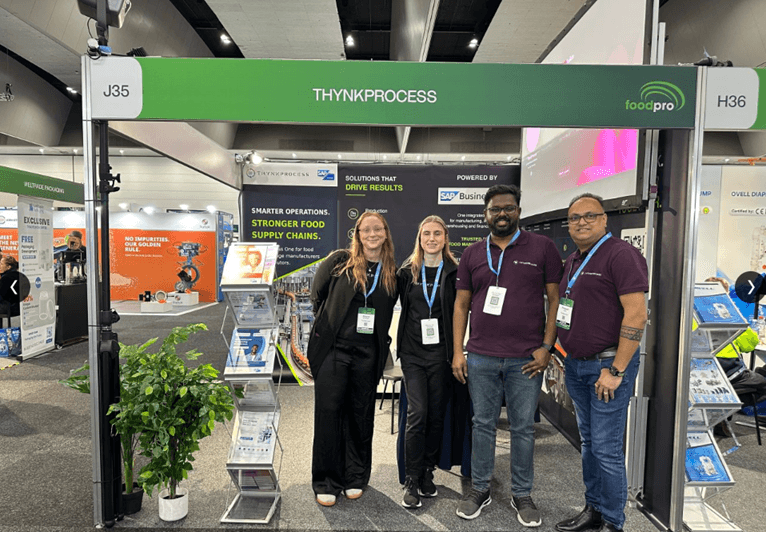
ThynkProcess is an Australian SAP Business One partner with specific experience in food and beverage manufacturing, wholesale distribution, and process manufacturing. ThynkProcess is/was at foodpro 2026 at Booth J35, 26–29 July, MCEC Melbourne.
Which of the three operator profiles above most closely matches your business — and what's the system gap that's costing you the most right now? We'd welcome the conversation.
Sources
- Food Standards Australia New Zealand (FSANZ), Australian food recall statistics 2025. foodstandards.gov.au/food-recalls/recallstats
- ERP Research, SAP Business One for Food & Beverage: Features, Benefits & Costs (2026). erpresearch.com
- OpsUI ANZ Community, SAP Business One Alternatives in NZ & Australia (2026). community.opsui.co.nz
- Equerra, Best ERP Software Australia 2026. equerra.com/au
- ERP Research, SAP Business One vs SAP ECC for Wholesale & Distribution (2026). erpresearch.com
- Sterling Team, SAP Business One Features in Food & Beverage Manufacturing (2026). sterling-team.com