
AFTER FOODPRO 2026 · BOOTH J35 FOLLOW-UP
What Happens After the Booth Closes
The full range of problems Australian food and beverage businesses brought to Booth J35 at foodpro 2026 — and the SAP Business One toolkit built to solve each one
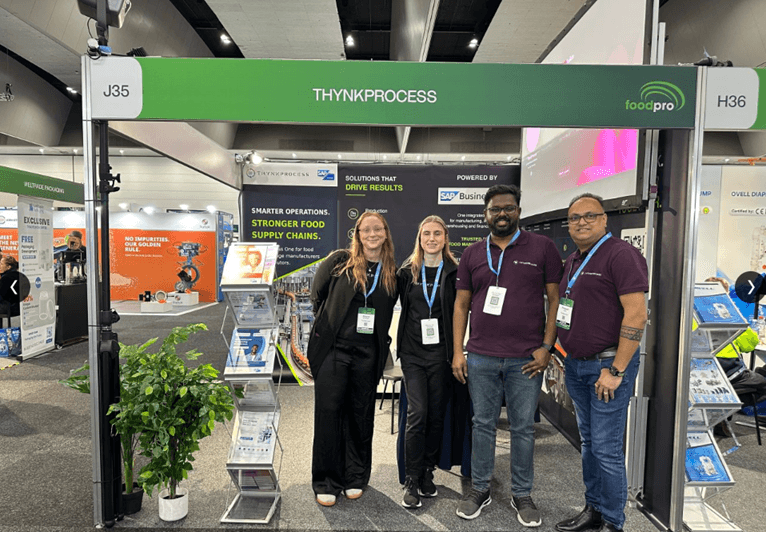
foodpro 2026 wrapped up after four packed days at MCEC Melbourne. In our last piece, we shared what was unfolding in real time on the show floor — the opening, the co-located AIFST Convention, and the steady stream of manufacturers, distributors, packagers and consultants who stopped by Booth J35.
We said then that the real story was in the conversations themselves. Now that the dust has settled and the follow-up calls have started, this piece goes further than our last update: the full range of problems raised at the booth, and — in proper detail — how SAP Business One and its manufacturing toolkit actually address each one.
| A note on what follows: the profiles below are composites, built from patterns we saw repeated across multiple conversations at the booth — not descriptions of any single business. We've deliberately changed identifying details, including location, to protect the privacy of everyone who spoke with us. What hasn't been changed is the substance of the problems themselves, because that's the part worth talking about. |
THE FULL RANGE OF ISSUES WE HEARD
Six recurring problems, across very different businesses
Before narrowing into specific stories, it's worth setting out the full landscape. These six categories cover the overwhelming majority of the operational conversations we had on the floor — from businesses already running SAP Business One to businesses that had never run a proper ERP at all.
| Problem Category | What It Looks Like Day to Day | Why It's Getting Worse |
| Production data drifting from reality | Bills of materials manually corrected inside the ERP; over- or under-production from inaccurate routing data | Manual correction doesn't scale as SKU count and production complexity grow |
| Warehouse and production tracked separately | Two disconnected systems, duplicate data entry, no real-time inventory accuracy | Retailer and regulator batch/lot requirements are tightening across most categories |
| Running on entry-level accounting software | MYOB or spreadsheets; manual production scheduling; costing calculated after the fact | New contract-manufacturing agreements increasingly demand real-time cost and traceability data upfront |
| Fragmented point solutions | Separate tools for finance, CRM, projects, inventory and service, with data re-entered across each | Every month of growth multiplies the manual reconciliation burden across more systems |
| Yield and batch traceability gaps | Unable to explain yield variance or trace which ingredient batches ended up in which finished product run | Export and major-retailer compliance requirements are tightening year on year |
| Limited customer-facing visibility | Customers can't self-serve order status, account pricing or catalog data online | Digital-first B2B buyers now expect ecommerce-level visibility even for account-based ordering |
Four of these conversations are worth walking through in real depth — both the specific issues raised, and the specific way the solution was mapped to the problem. Each one also touches a different part of the SAP Business One toolkit, so together they give a fairly complete picture of how the pieces fit.
BENDIGO, VICTORIA
When SAP B1 Isn't the Problem — But It Isn't Finished, Either
A mid-market food processor running SAP Business One for several years reached out after growing past what their original implementation was built to handle. The specific issues raised were concrete and recurring:
- Bills of materials manually corrected inside SAP B1 itself, flagged by the COO as costing hours every week
- Production yield reported in the system not matching what was actually coming off the line
- Warehouse and production data held in effectively separate silos, requiring duplicate entry to reconcile stock positions
- No real-time shop floor visibility for supervisors — production status only became clear at end-of-shift reconciliation
How this gets solved
- Beas Manufacturing adds accurate, multi-level bill-of-materials management with routing and true production costing, replacing manual BOM correction with data that reflects the actual production process
- Shop floor data capture through Beas gives supervisors real-time visibility into production status, rather than waiting for end-of-shift reconciliation
- Produmex WMS closes the warehouse side: batch and lot tracking, FEFO picking, and stock positions that update in real time as production and warehouse activity actually happens
The core financial and operational backbone here was already trusted — the fix was adding the manufacturing-specific and warehouse-specific layers that the original implementation was never built to include.
PARRAMATTA, NEW SOUTH WALES
Leaving Spreadsheets and Entry-Level Accounting Software Behind
A cluster of contract manufacturers and bottlers described a familiar pattern: running on MYOB or a mix of spreadsheets, with genuine operational strain building underneath it:
- Production scheduling tracked manually, with no visibility into capacity until a schedule was already committed
- Product costing calculated after the fact, once a production run was complete, rather than during planning
- No batch traceability at all — an issue that surfaced specifically while preparing to formalise a new contract-manufacturing relationship
- Finance and operations working from different numbers, reconciled manually at month end
How this gets solved
- SAP Business One replaces the patchwork with one connected system across finance, sales, purchasing, inventory and production — a single source of truth rather than a monthly reconciliation exercise
- Production costing becomes real-time rather than retrospective, because costs are captured as production happens, not calculated afterward
- B1 Usability Package (B1UP) adds workflow automation and approval processes on top — useful specifically for businesses making this jump for the first time, since it enforces the new process rather than relying on habit to change overnight
This is one of the most common transitions in the sector: a business that has genuinely outgrown entry-level accounting software, but hasn't yet made the jump because the perceived cost of transition feels larger than the daily cost of the workaround. In practice, the workaround usually costs more — in delayed numbers, in costing errors that quietly erode margin, and in traceability gaps that become a liability the moment a customer or regulator asks a direct question.
ADELAIDE, SOUTH AUSTRALIA
Yield and Traceability in Fresh and Blended Goods
A different theme entirely came from processors working with fresh produce and dry-blended ingredients, where the core question wasn't about finance software at all:
- Inability to explain variance between expected and actual yield at a level of detail anyone could defend to a customer or auditor
- No reliable way to trace which specific ingredient batches ended up in which finished product runs
- Manual, spreadsheet-based batch records that were time-consuming to produce and difficult to trust under scrutiny
- Rising pressure from retail and export customers for documented compliance, not just informal assurance
How this gets solved
- Produmex WMS provides batch and lot tracking as a structural part of how stock moves through the warehouse — not a separate record kept alongside the real system
- Beas Manufacturing ties that tracking back to production costing and yield reporting, so variance between expected and actual yield becomes visible and explainable rather than a mystery discovered at stocktake
- Full farm-to-finished-product traceability becomes a natural output of daily operations, generated as production happens rather than assembled under pressure when a customer or regulator asks
PERTH, WESTERN AUSTRALIA
One System, Instead of Six
A different kind of conversation came from an operator running service, inventory, project and finance functions across an unrelated stack of tools — a pattern common among manufacturers and manufacturing-adjacent service businesses that have grown by adding a new tool for each new function rather than one connected platform:
- Separate systems for accounting, CRM, project tracking, inventory and service reporting, none of which shared data with any other
- Data re-entered manually across multiple tools for the same transaction or job
- No single, trustworthy view for leadership — every report required manually reconciling exports from several systems
- Leadership explicitly wanting to consolidate under one platform, but unsure where to start
How this gets solved
- SAP Business One consolidates finance, inventory, sales and service under one platform, removing the need to reconcile exports from multiple disconnected tools
- B1 Usability Package (B1UP) adds the custom workflows, alerts and approval chains that replicate — and improve on — whatever process logic existed across the old point solutions
- The consolidation itself becomes the deliverable: fewer systems, one data set, and reporting leadership can actually trust without manual reconciliation
THE TOOLKIT BEHIND THESE SOLUTIONS
What each product actually does, and who it suits
Across all four conversations above, the same small set of products recurs in different combinations. Here is what each one does, on its own terms:
| Product | What It Does and Who It Suits |
| SAP Business One | The core ERP: finance, sales, purchasing, inventory and production in one connected system. Suits any business still running on entry-level accounting software, spreadsheets, or disconnected point tools, and wanting one source of truth across the operation. |
| Beas Manufacturing | Advanced production planning, bill-of-materials accuracy, routing and shop floor costing inside SAP Business One. Suits manufacturers whose production complexity has outgrown standard SAP B1 production functionality. |
| Produmex WMS | Warehouse management purpose-built for food-grade operations: batch and lot tracking, FEFO picking, and full traceability from goods-in to dispatch. Suits any business needing defensible batch traceability for compliance or recall readiness. |
| Produmex Scan | Mobile barcode scanning on the warehouse floor, connected directly to SAP Business One in real time. Suits operations still reconciling paper pick-lists or spreadsheets at the end of each shift. |
| B1 Usability Package (B1UP) | Workflow automation, custom alerts and approval processes layered onto SAP Business One. Suits businesses consolidating multiple disconnected tools who need enforced processes rather than relying on manual follow-up. |
THE PATTERN ACROSS ALL FOUR
Four Cities, One Underlying Story
| Location | Business Type | Core Challenge | Where the Fit Is |
| Bendigo, VIC | Mid-market food processor, existing SAP B1 user | BOM accuracy and warehouse tracking outgrowing original setup | Beas Manufacturing + Produmex WMS |
| Parramatta, NSW | Contract manufacturer / bottler on MYOB and spreadsheets | Real-time costing and traceability ahead of a new contract | SAP Business One + B1UP |
| Adelaide, SA | Fresh processor and dry-blend manufacturer | Yield variance and batch-level traceability | Produmex WMS + Beas Manufacturing |
| Perth, WA | Multi-function operator across service, inventory and projects | Fragmented systems; leadership wants one platform | SAP Business One + B1UP |
Bendigo, Parramatta, Adelaide and Perth have very little in common on the surface — different products, different scale, different stages of their systems journey. But the underlying pattern across nearly every conversation at Booth J35 was the same: businesses that have grown past what their current systems, however well-intentioned at the time, were originally built to handle.
That is the real value of an event like foodpro. Not that it introduces manufacturers to new software, but that it gives them the room to say, out loud, to someone who understands food and beverage operations specifically: here's what's actually not working. That is a harder conversation to have internally than it should be — and it is exactly the conversation Booth J35 was there for.
If any of these situations sound familiar, wherever you're reading this from, that conversation is still open.
Which of these situations is closest to what your business is dealing with right now? We'd genuinely like to know — drop a comment or reach out directly.
foodpro 2026 · Booth J35 Follow-Up · ThynkProcess