
The contract that almost broke them
Picture a $45 million beverage manufacturer in regional Queensland. After two years of courting, they finally won a national retail listing — triple their largest existing account. The kind of win that's supposed to change a business.
Six weeks in, it nearly did. The wrong way.
New product codes were being created manually in three different places, and they didn't always match. Costing for the new SKUs was built in a spreadsheet that one person understood. A pricing error on a rebate calculation wasn't caught until the second invoice run. Production scheduling, still done on a whiteboard and a shared spreadsheet, couldn't keep pace with the new order cadence on top of existing customers.
Nothing had technically failed. There was no single dramatic incident. But the business was being run at the edge of what its systems — or lack of them — could absorb. And the new contract had just removed all the slack.
(This is a composite scenario, built from patterns seen repeatedly across mid-market manufacturers — not a single client account.)
A sector that's growing — on a fragile foundation
This pressure point is showing up against the backdrop of a sector that is, on paper, performing well. According to the Australian Food and Grocery Council's State of the Industry reporting, sector turnover reached $173 billion in 2023-24, up 5.3% year-on-year, with employment climbing 4.4% to support almost 300,000 jobs, more than a third of them in regional Australia.
That growth is real. But the AFGC's own Towards 2030 snapshot is candid about what's sitting underneath it: rising costs, sustained margin pressure, and persistent investment gaps that constrain long-term growth. Capital expenditure by food manufacturers has been largely stagnant for the past decade, even as the operating environment has become more complex.
The sector is also overwhelmingly small and medium enterprises by business count, even though large companies capture most of the revenue and headcount. That combination — SME-dominated, thin on systems investment, growing turnover — is exactly the environment in which a single large new contract can outpace what the back office can handle.
Growth doesn't create the problem — it reveals it
This is a pattern seen consistently across Australian mid-market food and beverage manufacturers, typically in the $20 million to $100 million revenue range. The systems that worked perfectly well at an earlier stage — a costing spreadsheet here, a production whiteboard there, a separate quality log, an inbox full of rebate agreements — were never actually fixed. They were simply not yet under enough pressure to fail visibly.
Growth changes that. More SKUs. More customers. More compliance requirements. More complexity in changeovers and batch tracking. Each new layer adds strain to a foundation that was never designed to scale.
The businesses that struggle most with growth are rarely under-resourced. They are under-systemised.
And the symptoms tend to show up in the same places:
• Costing and pricing built and maintained in spreadsheets, often by one person
• Batch and lot records kept on paper or in disconnected logs, slowing recall response
• Rebate and contract pricing terms tracked manually, with errors surfacing only at invoicing
• Production schedules that exist in someone's head, a whiteboard, or both
• Finance, production and quality data that never reconcile automatically
Why this matters more for food and beverage specifically
In general manufacturing, these gaps are inconvenient. In food and beverage, they carry sharper consequences — and the national recall data makes the point clearly. Food Standards Australia New Zealand (FSANZ) coordinated 92 food recalls in 2025, above the ten-year average of 87, continuing an upward trend over the past decade. Undeclared allergens remain the leading cause, responsible for 38% of all 2025 recalls, with packaging errors, accidental cross-contamination and failure to communicate ingredient changes the main contributing factors.
FSANZ's own 2017 cost analysis put the average direct cost of a food recall at around $10 million, before accounting for the long-term hit to brand reputation and customer trust. A manufacturer can absorb a clunky spreadsheet for years when volume is steady and the customer base is familiar. The moment that changes — a new contract, a new market, a new compliance requirement — the cracks in that foundation become very expensive, very quickly, and traceability is usually where they show up first.
A workforce squeeze is compounding the systems gap
The systems problem is also colliding with a structural workforce shift. Research from Oxford Economics, commissioned by the AFGC, projects a gap of approximately 5,000 packers by 2035, as roughly half of the current packer workforce moves into other roles faster than education and migration pipelines can replace them. Across several occupations critical to food manufacturing, more than 40% of the current workforce is expected to leave within the decade through retirement alone — among forklift drivers, that figure reaches 60%, around double the national average.
That matters directly to the systems conversation. The institutional knowledge currently compensating for disconnected systems — the person who 'just knows' how costing works, or where the current production schedule really stands — is itself walking out the door over the next decade. Manual workarounds depend on people who are becoming harder to retain and replace.
The real cost of growing without systems
Put together, the data points to a cost that rarely shows up as a single line item. It shows up as:
- Margin compression that's hard to diagnose, because costing data isn't trustworthy
- Extended recall response times, against a national backdrop of rising recall frequency
- Key-person risk, sharpened by a workforce ageing out faster than it's being replaced
- Missed growth, because leadership hesitates to chase contracts the business isn't confident it can fulfil cleanly
That last point is the one that matters most. Disconnected systems don't just create operational risk — they quietly cap ambition. Leadership teams start saying no to growth they could otherwise win, because they already know what happens to the back office when volume spikes.
The numbers at a glance
| Metric | Figure |
| Australian food & grocery manufacturing turnover (2023-24) | $173 billion, up 5.3% YoY |
| Sector employment (2023-24) | ~293,000 jobs, up 4.4% YoY; over a third regional |
| Food recalls coordinated by FSANZ (2025) | 92, above the 10-year average of 87 |
| Share of 2025 recalls due to undeclared allergens | 38% |
| Estimated average direct cost of a food recall | ~$10 million (FSANZ analysis) |
| Projected packer workforce gap by 2035 | ~5,000 workers (Oxford Economics / AFGC) |
| Workforce attrition risk among forklift drivers (10yr) | Up to 60%, ~2x national average |
Where this series is heading
This is the first in a short series leading into foodpro 2026. Over the coming weeks, the focus will shift from the problem to the landscape of solutions — what enterprise software actually exists for mid-market food and beverage manufacturers, how to evaluate it, and what a right-sized system looks like in practice.
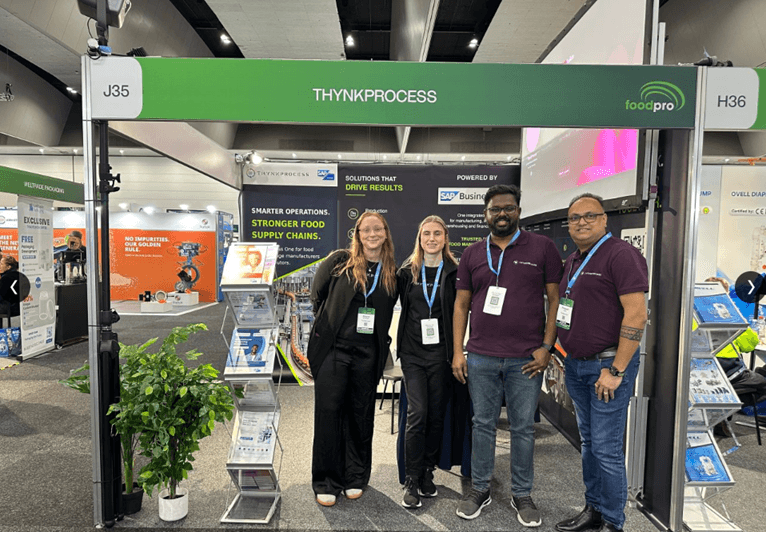
ThynkProcess will be exhibiting at foodpro 2026, Booth J35, from 26–29 July at MCEC Melbourne.
Has a growth moment ever exposed a system gap in your operation? What broke first — costing, scheduling, traceability, something else?
Sources
- Australian Food and Grocery Council, State of the Industry 2023-24 report and Towards 2030: A Food and Grocery Snapshot, afgc.org.au
- Food Standards Australia New Zealand (FSANZ), Australian food recall statistics, foodstandards.gov.au/food-recalls/recallstats
- Oxford Economics Australia, Workforce pressures facing the food & grocery manufacturing sector (commissioned by AFGC), oxfordeconomics.com